
Carefree Water Security
Annual water volume has dropped significantly in the Colorado River system and those reductions are believed to be symptoms of a new, reduced average supply. The Colorado is shared among seven states and 30 federally recognized Colorado Basin Indian tribes, so new allocations must be negotiated and unresolved tribal claims must be accommodated. The Town of Carefree currently receives about 69% of its annual supply from the Colorado system, so it is obviously important for the Town to monitor these changes and take action to safeguard our water future.
Despite these uncertainties, however, Carefree is in a relatively strong position regarding its entitlement to water. The Town has developed a legal framework to handle quite large supply shocks, but though we are generally well positioned for these possible events it is in this area that forward thinking plans are still necessary.
First is a brief discussion of the facts as they exist today.
As suggested above, the biggest portion of Carefree water usage, both by entitlement and by actual usage, is from the Colorado River through the Central Arizona Project (CAP). We also have a modestly sized aquifer (the Carefree sub-basin) that makes a significant contribution (all quantities are annual withdrawals in acre-feet, or AF):
| Source | Allocation | Current (est) | Max Build-out (est) |
| CAP | 1,790 | 929 | 1,170 |
| Carefree Aquifer | 500 * | 411 | 433 |
| Total | 2,290 | 1,340 | 1,603 |
‘* Carefree aquifer “allocation” is the allowed amount of ‘non-emergency’ use water available for withdrawal by agreement with Scottsdale (more can be withdrawn in emergency situations).
Note 1: The ‘Current’ column contains the Carefree Water Company’s (CWC’s) estimate for water usage going forward, assuming current development. The Tom Darlington reservoir has been completely on-line for more than a month now. As the primary water source for the entire southwest portion of Carefree (north of Carefree Highway and west of 64th Street) it provides potable water and fire flow to area residents as well as the commercial area near the Cave Creek and Carefree Hwy intersection. Since achievement of this milestone marks the virtual completion of the Carefree Water Consolidation Project, the quantities in this column can also serve as an estimate for 2024 calendar year.
Note 2: The CAP allocation includes 112 AF of NIA (non-Indian agricultural) allocation that is among the first water allocations to be withdrawn in times of Colorado River shortages. The rest of the allocation (1,678 AF) is M&I (Municipal and Industrial) allocation, which conveys much higher priority rights.
The first point to note is that our current CAP allocation would be sufficient for all anticipated use in Carefree, even at full Town build-out. And this is true even if NIA water is not included.
Again, long-term Colorado River water deliveries are under threat due to a long-term drying trend at the Colorado headwaters. While very concerning, these threats are expected to hit agricultural users hardest (they currently account for 72% of all water consumption in Arizona), with municipalities expected to be relatively less affected.
Our relatively large CAP allocation also allows Carefree to use CAP water exclusively for permitting all future development, which eliminates the need for demonstrating 100-year assured water supplies. And this is fortunate because we can’t currently assure 100-year availability from our aquifer.
The Carefree Water Company’s (CWC’s) best estimate is that current aquifer withdrawal amounts by Carefree, Scottsdale and private wells is approximately equal to the recharge rate, so our current usage of 400 AF per year may well be sustainable. This estimate, however, is based on very limited data and could well be significantly in error, so it is currently not possible to certify any aquifer usage rate as sustainable. It might therefore seem prudent to increase our current usage of CAP water in order to reduce aquifer usage significantly until we have more reliable information on sustainability, but this type of water conservation strategy would come at a cost. This is because the cost to the CWC for aquifer water is less than 20% of the cost of CAP water. Reducing the usage of aquifer water from the current 411 AF per year to a more conservative 300 AF would increase total water acquisition costs by more than 20%, which would obviously show up eventually in higher customer rates.
Finally, water and energy provider SRP is studying a proposed enlargement of Bartlett Reservoir on the Verde River in the Salt River Project region, and Carefree is a project participant. This project, if realized, could eventually provide Carefree with an average of 300 AF of additional water per year, though it would come very irregularly, with individual year deliveries ranging from zero to possibly 1,200 AF. There is currently no plan to manage and incorporate such a variable supply into the CWC system, but the project is not yet approved and is still many years away from completion.
The recent Carefree Water Consolidation Project has brought almost all Town residents into the Carefree water system, further increasing our CAP surplus while extending our relatively privileged position on water security to nearly all our residents. There are certainly challenges ahead, and careful management of our CWC system and water acquisition choices will be necessary. But Carefree’s ample CAP allocation, sizable aquifer, and possible access to a future third water source make the Town very well situated to deal with future changes in Arizona water availability.
Carefree Unity 3/21/2024
States Propose Colorado River Conservation Plans
The Federal Bureau of Reclamation, tasked with establishing a sustainable long-term conservation plan for water deliveries in the Colorado River system, has long tried to meet its obligation through consensus among the seven Colorado Basin states. Historically this has been a contentious process that has dragged on year after year as water levels have continued to fall, but last May the states finally reached a historic deal, which was formally accepted last week by the Bureau. The catch? This is a short-term deal that will expire in 2026.
A long-term deal still has major obstacles, but some progress has been made. The Navajo Nation and Hopi and San Juan Southern Paiute Tribes have recently reached agreements for water rights for both the upper and lower basins, leaving the Gila River Indian community as the largest traditional user pursuing an independent path. California and Arizona have agreed to a compromise framework for dealing with Arizona’s legal position as junior rights holder, which had been an unresolved issue until recently. And all seven states have agreed that the provisions of the short-term deal will also apply long term, as long as water levels in system reservoirs remain where they currently are.
But of course, water levels are not expected to remain where they are. The good news is that there are now only two major long-term plans, which were both unveiled last week. Less positive news is that there is a very wide gap between them. The upper basin states (Colorado, Utah, New Mexico and Wyoming) propose that further drops in water levels of Lake Powell and Lake Mead will lead to reductions in water releases to the lower basin states (Arizona, California and Nevada). In contrast, the lower basin states propose to add an additional five (upper basin) reservoirs to the measurement system, and to apportion any additional cutbacks in water usage across all seven states in both basins.
The Bureau of Reclamation has established the deadlines and will continue to apply pressure to move the process forward, and though the issues are still very large, the trajectory is positive.
It is still too early to report projected outcomes, but for residents of Carefree some aspects are coming into focus. Whatever the final compromise, the following elements are virtually certain:
· The Colorado River system will continue to falter, and the 1.5 million acre-feet reduction that the lower basin states have agreed to in the short-term will eventually be reduced further, perhaps modestly but possibly to a total of about 4 million acre-feet, because the sustainable annual flow for the system is likely to ultimately be 11 million acre-feet or less, rather than the 15 million acre-feet that is now allocated.
· Arizona, with our junior water-rights status, will take the largest cut on a percentage basis. The short-term deal has already cut the Arizona allocation by more than 20%, and it is very realistic to expect much larger reductions in the future.
· The Colorado River accounts for about 40% of Arizona water consumption, and a roughly equal amount comes from groundwater, which is also currently being used at an unsustainable rate. Though most of the remaining 20% is from more sustainable sources (Salt and Verde rivers, high quality treated wastewater), the total sustainable water use in Arizona is clearly much lower than current consumption.
· Federal approval of the Central Arizona Project is the historical reason for the junior water rights status of Arizona, and supplies through the CAP will face special uncertainties.
Carefree is primarily supplied through the CAP, but there are some special factors that make our water supply more secure than most neighboring municipalities. We will publish a detailed look at the situation for Carefree in a follow-on report.
Carefree Unity March 12, 2024
Arizona Groundwater Shortfall
Carefree is Outside Affected Study Area June 7, 2023
As has been widely reported, last week Arizona announced groundwater restrictions that could slow new residential development within the Phoenix Active Management Area (AMA).
A new Arizona Department of Water Resources (DWR) study of groundwater supplies within the Phoenix AMA has found the system to be overallocated by 4.86 Million acre-feet over the next century, and for this reason no new Certificates of Assured Water Supply (CAWS) will be issued within the AMA based on groundwater withdrawals. Without a CAWS, new residential developments cannot proceed.
Despite lying within the Phoenix AMA, the Carefree aquifer (technically the Carefree Sub-basin), was not part of the recent groundwater study, which was restricted to the Hassayampa and East and West Salt River valley sub-basins. No study has yet been done to determine sustainable withdrawals from the Carefree sub-basin.
As is true for many valley communities, potential new development in Carefree is expected to be unaffected by this new policy, however. Though the Town does not have an official Assured Water Supply designation, it is supplied exclusively by the Carefree Water Company which has a Central Arizona Project (CAP) designation of 1,300 acre-feet per year, nearly 25% more than current annual use. It has been recent DWR practice to issue new Certificates of Assured Water Supply based on the Water Company’s unused CAP allocation, and no change to that policy was indicated in a meeting with DWR last week that was attended by Carefree Water. Though Carefree does withdraw groundwater from wells in the Carefree aquifer, no new withdrawals are expected to be needed to support any possible new residential developments.
Carefree Unity 6/07/2023
States Agree on Colorado Basin Plan May 23, 2023
California, Arizona and Nevada Request Bureau of Reclamation Study
The Lower Colorado Basin states (California, Arizona, and Nevada) informed the U.S. Bureau of Reclamation yesterday (5/22/23) of an agreement reached among the states to conserve at least 3 million acre-feet (MAF) of Colorado River Water by the end of calendar year 2026. The Bureau of Reclamation responded by temporarily withdrawing the Draft Supplemental Environmental Impact Statement it had published last month in order to study the proposal.
Last June the Department of Reclamation testified to Congress that the Lower Basin states needed to conserve 2 to 4 MAF annually to protect storage volumes in the system. The states took advantage of an easing of the crisis (caused by the watershed’s largest winter snowpack since 1997) to propose a smaller but still substantial conservation plan to meet the short-term crisis, according to the Director of the Kyl Center for Water Policy, Sarah Porter. “The states demonstrated they could work together to find a deal” Ms. Porter said, and this is very encouraging for the long-term health of the River, which is governed by the “Law of the River,” a bewilderingly complex body of agreements, court decisions, contracts and decrees that has developed over the past century.
The commitment is for System Conservation, water that will be permanently added to conserved storage volumes. Water use reductions will be achieved voluntarily, and most conservators will be compensated. Compensation may come from states or local entities, but most will utilize a provision of the Inflation Reduction Act passed by Congress last year, which included a provision specifically for this purpose.
In the past the lower basin states had repeatedly failed to come to agreement, which had raised the possibility that a new allocation regime might have to be imposed by the U. S. Bureau of Reclamation, an outcome that could well have led to court challenges and delays. That outcome will remain possible until the states finalize all details, and the plan is analyzed and accepted by the Department of Reclamation. At this point success seems likely however, and the agreement raises hopes that the three states will also be able to work together on the post-2026 operating guidelines, which will become the next major challenge in preserving the long-term sustainability of the Colorado River watershed.
Carefree Unity 5/24/23
Rapidly Worsening Water Outlook
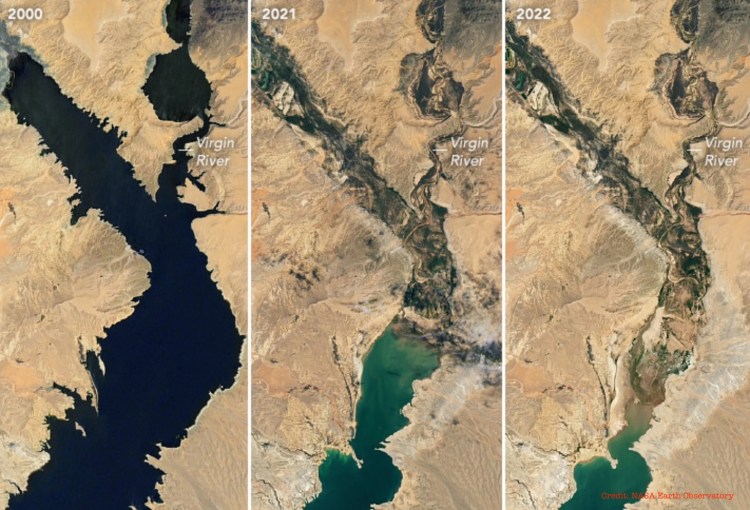
Joanna Allhands* 8/16/2022 Apparently, the plan to save a tanking Lake Mead and Lake Powell is ‘stay tuned
Lake Mead is dying, and Reclamation’s response is ‘stay tuned
When will Arizona run out of water? Why that’s the wrong question to as
Joanna Allhands* 5/31/2022
When Will Arizona Run Out of Water
Who ‘deserves’ Arizona’s water? Our future rests on this and 3 other questions
Joanna Allhands*4/12/2022
4 utterly important water questions for Arizona that almost no one is talking about
Joanna Allhands
4 Utterly Important Water Questions
Joanna Allhands* 3/21/2022
Opinions digital editor at The Arizona Republic and azcentral.co
I oversee opinions content on azcentral.com, in video and through social media. I also regularly write about Arizona water and education policy
Joanna Allhands has emerged as a premier commentator on water policy in Arizona and the desert southwest. We encourage readers to check this page often as Carefree Unity intends to regularly post links to her articles and is open to posting links to other articles and opinions on water policy as we become aware of them.
 Carefree Unity
You must be logged in to post a comment.